

Transcript#
This transcript was generated automatically and may contain errors.
Hi folks, my name is Kristin Bott and I'm coming to you as one of the co-leads for the Pride Employee Resource Group at PawsitPBC. Today I'm going to be talking about building community at work. Now thinking about ways that folks tend to approach this, I think it's very classic to do big things. So maybe you bring in a speaker to approach a somewhat heady topic like how to be your authentic self at work. Or there's always the classic drag bingo. Now I think this is a really fun thing to do.
People love this as an event. And people tell us things like, oh my kids really look forward to it. This is one of the highlights of our summer. And come on, who doesn't love a queer dance break in the middle of the workday?
So this is a great event. This is something we want to keep. And yet we wanted to see what else might meet the needs of our community. What else could we do? Maybe one way to think about this is if you have a big event, you have a speaker or an entertainer, you have people listening. They're all paying attention to that one speaker. But if you take the speaker away, you provide an opportunity for people to connect with one another.
Small-format community events
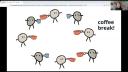
So idea number one, how about a coffee break? This is 45 minutes. We do this monthly. Bring whatever beverage you have to have. Join when you can. Leave when you have to. So this is a nice place to chat in a relatively small group. You can do things like meet people's pets or see their apartments. You can hear about their latest art project or talk about the weather. And sometimes this is also the right environment for more deep and involved conversations like how are you really doing?
This has landed really well with people. And yet what else can we do? Who could we reach by doing something slightly different? Enter the pride game break. This is half an hour every month. We get folks together and do something fun, play some kind of game together. So we've had Jeopardy, trivia games, drawing games like Gartic Phone. I think this works really well because it gives people a third thing, something to do together, something to connect through without the same dynamics as a direct full-on conversation.
Queer lightning talks
Okay, that's great. What else? The newest addition to our lineup is something we're calling Queer Lightning Talks. So yes, you have the dynamic I described earlier of people all paying attention to the same person, but the presentations are short and the people speaking are our own. Topics are completely open-ended, work, non-work, whatever folks choose to speak about. Some recent talk topics include a deep dive on animal communication from someone with a PhD in neuroscience, a story complete with visuals about the challenging journey of knitting your first pair of socks, a run-through of a previous iteration of this talk, and a five-minute walkthrough of how to turn yourself from a human into a creature from another planet.
And while these topics are all light and fun, sometimes things get a little more interesting. So one of our members is known for fantastic clubbing outfits, and so we asked him to put together some slides about that. And this turned into a really interesting discussion of costumes versus outfits and how what you wear intersects with your identity.
Is it working?
So that's all well and fine and fun, but the question we're probably asking ourselves as data-based people is, is any of this working? So I asked our membership what they thought, and I received far more feedback than I could fit on this slide, but here are some key quotes for those messages. And I'll pause for a minute here so you have a chance to read.
And of course you can come back to the slides later. So to briefly close out, to echo one of our community members on that last slide, I think community is built through the many small actions. You don't need big events, you don't need a big budget. If you're trying to get folks together, consider providing multiple options. And if you have a new idea, give it time before you decide whether it's a success or a failure. And of course, always stay plugged into your community and get feedback.
I think community is built through the many small actions.
Thank you all so much for listening, and a shout out to all of our Pride ERG co-leads, current and past, as well as our executive sponsors. I'd love to talk about any of this, so please do get in touch. Thank you so much.